Listen to the hum of the planetary mixer. It is the sound of industrial physics masquerading as a kitchen appliance. We are not merely making a topping; we are constructing a structural masterpiece of lipid globule encapsulation. When you engage in high-volume Whipped Cream Aeration, you are acting as a mechanical engineer of the palate. You are forcing atmospheric gases into a viscous liquid matrix, trapping air bubbles within a network of partially coalesced fat droplets. The sensory reward is immediate. It is the velvet weight of the cream against the tongue, the sudden explosion of sweetness, and the structural integrity that allows a dollop to stand defiant against gravity. To the untrained eye, it is a cloud. To the culinary auditor, it is a stabilized foam where temperature control is the only thing preventing a total systemic collapse into butter. We demand precision because the difference between a silken finish and a grainy, over-sheared failure is measured in seconds and single degrees of Celsius.
THE DATA MATRIX
| Metric | Specification |
|---|---|
| Prep Time | 10 Minutes |
| Execution Time | 5 Minutes |
| Yield | 1.5 Liters / 6 Cups |
| Complexity (1-10) | 4 |
| Estimated Cost per Serving | $0.22 |
THE GATHERS
Ingredient Protocol:
- 480ml / 2 cups Heavy Whipping Cream (Minimum 36% Butterfat).
- 60g / 0.5 cup Confectioners Sugar (Sifted).
- 5ml / 1 tsp Pure Vanilla Extract (High Vanillin Content).
- 2g / 0.25 tsp Cream of Tartar (Optional Stabilizer).
Section A: Ingredient Quality Audit:
If your cream arrives with a butterfat content below 36%, your Whipped Cream Aeration will suffer from structural instability; the foam will weep and deflate within thirty minutes. To fix this, infuse a small amount of mascarpone or gelatin to reinforce the lipid walls. If the sugar is clumpy, it creates grit in the viscous matrix. Always use a fine-mesh sieve to ensure the particles are small enough to dissolve instantly. If the vanilla extract contains high alcohol levels and low oil content, it may slightly destabilize the emulsion. Opt for vanilla bean paste to maintain the density of the globule network.
THE MASTERCLASS
Step-by-Step Execution:
1. Thermal Stabilization of the Infrastructure
Place your stainless steel mixing bowl and wire whisk attachment into the freezer for at least 20 minutes. Use a digital infrared thermometer to ensure the equipment surface temperature is below 4 degrees Celsius.
Pro Tip: Fat globules in the cream must remain in a semi-solid state to trap air. If the equipment is warm, the lipids will melt and fail to bridge together; this results in a liquid mess that cannot hold a peak.
2. The Initial Infusion
Pour the chilled heavy cream into the bowl and add the sifted sugar and vanilla. Use a digital scale for the sugar to ensure the weight is exact, as volume measurements for powdered substances are notoriously unreliable in high-volume production.
Pro Tip: Adding sugar at the start provides a slight increase in viscosity, which helps to slow down the movement of air bubbles and creates a finer, more uniform pore structure during the early stages of aeration.
3. Low-Velocity Integration
Start the mixer on the lowest setting for 60 seconds. This is the "induction phase" where you are simply distributing the solutes into the solvent.
Pro Tip: Starting at high speed immediately creates large, unstable air pockets that are prone to popping. A slow start ensures a dense population of micro-bubbles that serve as the foundation for the final foam.
4. High-Shear Aeration
Increase the mixer speed to medium-high. Watch for the cream to transition from a watery liquid to a thickened, trailing state. Use a silicone spatula to scrape the sides of the bowl once to ensure no un-aerated liquid remains at the bottom.
Pro Tip: At this stage, the mechanical energy of the whisk is stripping the protective membranes from the fat globules. This allows them to stick to one another and form a protective cage around the air bubbles.
5. The Stiff Peak Finalization
As the whisk leaves distinct "tracks" in the cream, reduce the speed to medium. Stop the mixer frequently to check the texture. You are looking for "stiff peaks" where the cream stands straight up when the whisk is lifted.
Pro Tip: The transition from soft peaks to over-whipped butter happens in a heartbeat. Reducing the speed gives you a wider margin of error to achieve the perfect structural density without breaking the emulsion.
Section B: Prep & Timing Fault-Lines:
The most common human error is the "set it and forget it" mentality. If you walk away from a mixer during Whipped Cream Aeration, you will return to a bowl of sweet butter and buttermilk. If the room temperature is above 25 degrees Celsius, the aeration process must be accelerated or performed over an ice bath. Timing is also critical; whipped cream should be prepared as close to service as possible. If it must be stored, it requires a stabilizer like xanthan gum to prevent the water from migrating out of the lipid network.
THE VISUAL SPECTRUM
Section C: Thermal & Visual Troubleshooting:
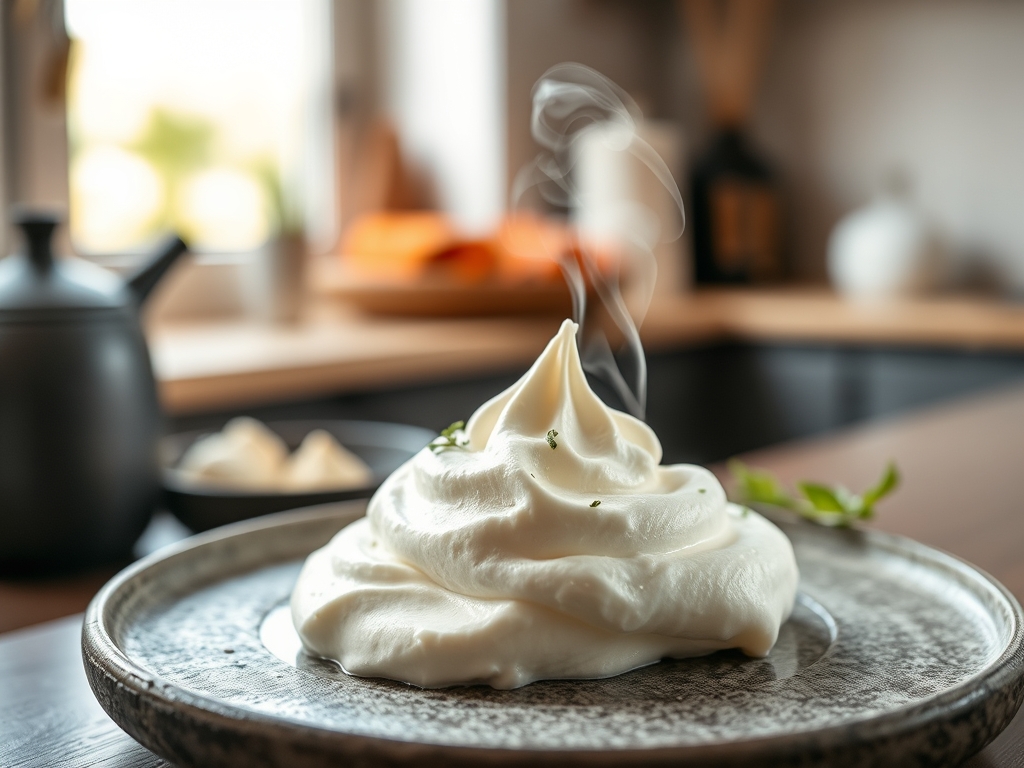
Observe the photo above. The cream should possess a high-gloss sheen and a brilliant white hue. If the cream looks dull or matte, it is likely over-aerated and beginning to turn to butter. If the texture appears "pock-marked" or grainy, the fat globules have begun to clump too aggressively; you can sometimes salvage this by gently folding in two tablespoons of un-whipped liquid cream to smooth the matrix. Uneven browning is not an issue here, but "yellowing" indicates the cream was not fresh or was exposed to heat during the transport phase of the supply chain.
THE DEEP DIVE
Macro Nutrition Profile
Per 100g serving, expect approximately 340 calories, 36g of fat, 3g of carbohydrates, and 2g of protein. This is a high-density lipid delivery system designed for satiety and flavor carriage.
Dietary Swaps (Vegan/Keto/GF)
For a Vegan alternative, use full-fat coconut cream chilled for 24 hours. The high saturated fat content mimics the lipid globule encapsulation of dairy. For Keto, replace confectioners sugar with powdered erythritol or allulose. The recipe is naturally Gluten-Free.
Meal Prep & Reheating Science
Never reheat whipped cream; heat will instantly collapse the foam as the fat melts. To maintain molecular structure for 24 to 48 hours, store the cream in a chilled piping bag inside an airtight container. This prevents the cream from absorbing "fridge odors" and minimizes the surface area exposed to oxygen, which can lead to lipid oxidation.
THE KITCHEN TABLE
How do I fix over-whipped cream?
If it has not yet turned to butter, gently fold in a few tablespoons of cold, liquid heavy cream by hand. This reintroduces moisture and helps to smooth out the jagged, over-coalesced fat globules for a silkier finish.
Can I use granulated sugar instead?
Granulated sugar is heavy and abrasive. In a high-volume Whipped Cream Aeration protocol, it may not dissolve fully, leaving a gritty texture. Confectioners sugar contains a small amount of cornstarch, which actually aids in stabilizing the final foam.
Why did my cream fail to thicken?
The most likely culprit is temperature. If the cream or the bowl is above 7 degrees Celsius, the fat globules cannot maintain the rigidity needed to trap air. Always chill your infrastructure before beginning the aeration process.
How long will it stay stable on a cake?
Without stabilizers, pure whipped cream will begin to lose its structure within 2 to 4 hours at room temperature. For long-term display, incorporate a "stabilized" method using gelatin or a specialized commercial whipping powder.