Stop staring at that carton of refrigerated disappointment. You are not just making breakfast; you are conducting a high-stakes structural engineering project involving the rapid expansion of globular proteins. Welcome to the Soufflé Omelet Audit. Most home cooks treat eggs like a chore, but we treat them like a pressurized vessel. We are looking for maximum volume, a viscous interior, and a structural integrity that defies gravity. If your current omelet looks like a deflated yellow envelope, your infrastructure has failed. We are here to rectify that with a rigorous protocol focused on denaturation and mechanical aeration. We are not just whisking; we are building a lattice of air trapped within a delicate matrix of albumin. This is the intersection of fluid dynamics and gastronomy. Prepare to overhaul your morning routine with a dish that vibrates with energy and precision. We demand a golden exterior and a cloud-like core that feels like eating a savory marshmallow. Let us begin the audit of your kitchen capabilities and the transformation of the humble egg.
THE DATA MATRIX
| Metric | Specification |
|---|---|
| Prep Time | 8 Minutes |
| Execution Time | 5 Minutes |
| Yield | 1 Serving |
| Complexity (1-10) | 7 |
| Estimated Cost per Serving | $1.25 |
THE GATHERS
Ingredient Protocol:
- 3 Large Eggs (Room Temperature) / ~150g
- 15ml / 1 tbsp Unsalted Butter (High Fat Content)
- 2g / 0.5 tsp Fine Sea Salt
- 1g / 0.25 tsp Cream of Tartar (Acidic Stabilizer)
- 15g / 1 tbsp Fresh Chives (Finely Minced)
- 30g / 2 tbsp Gruyere Cheese (Micro-planed)
Section A: Ingredient Quality Audit:
Fault: Cold Eggs. If your eggs are straight from the refrigerator, the proteins are tight and resistant to expansion. The Fix: Submerge whole eggs in a bowl of warm water for five minutes to reach an internal temperature of 21 degrees Celsius. This ensures the whites aerate with 30 percent more efficiency.
Fault: Low-Fat Butter. Using "light" butter or margarine introduces excess water into the pan. This creates steam that can collapse the omelet base. The Fix: Use European-style butter with at least 82 percent butterfat to render a stable, non-stick surface that promotes even browning.
Fault: Coarse Salt. Large crystals do not dissolve quickly enough in the foam, leading to structural weak spots. The Fix: Use a digital scale to measure fine sea salt or pulverize kosher salt in a mortar and pestle for immediate integration.
THE MASTERCLASS
1. The Separation Protocol
Carefully separate your whites from the yolks into two clean glass bowls. Any trace of lipids in the whites will sabotage your volume. Use a digital scale to ensure your yolks are roughly 50 to 60 grams of the total weight.
Pro Tip: The science of emulsification relies on clean equipment. Even a microscopic smear of grease on your whisk will prevent the albumin from forming the necessary peaks. Wipe your bowl with a drop of lemon juice first.
2. High-Velocity Aeration
Add the cream of tartar to the whites. Using a balloon whisk or a high-speed hand mixer, beat the whites until they reach stiff peaks. You are looking for a glossy finish that holds its shape when the whisk is inverted.
Pro Tip: This is mechanical denaturation. You are unfolding protein strands and trapping air. The cream of tartar acts as a stabilizer; it lowers the pH to prevent the proteins from over-bonding and squeezing out the air.
3. The Yolk Integration
Lightly beat the yolks with salt until they are pale and viscous. Gently fold one-third of the whites into the yolks to lighten the density. Then, fold the yolk mixture back into the remaining whites using a silicone spatula.
Pro Tip: Use a "cut and fold" motion. Do not stir. Stirring destroys the air bubbles you just spent five minutes creating. Your goal is a uniform, pale yellow foam that still feels light and bouncy.
4. Thermal Application
Heat a 10-inch non-stick skillet or a saucier over medium-low heat. Add the butter and wait for the foaming to subside. Pour the mixture into the pan and smooth the top with a bench scraper or spatula. Cover with a lid for three minutes.
Pro Tip: The lid is essential. It creates a convection environment that cooks the top of the omelet via steam while the bottom develops a golden crust. This ensures the center remains piquant and soft without being raw.
5. The Final Fold
Once the edges are set and the center is no longer jiggling violently, sprinkle the Gruyere and chives over one half. Use a wide offset spatula to fold the omelet in half. Slide it onto a warmed plate immediately.
Pro Tip: The residual heat will continue to melt the cheese. If you leave it in the pan too long, the bottom will over-brown and develop a sulfurous aroma. Timing is the difference between a masterpiece and a rubber mat.
Section B: Prep & Timing Fault-Lines:
Fault: Premature Whisking. If you whip your whites and then walk away to chop chives, the foam will weep. This is syneresis. The Fix: Always prep your "mise en place" entirely before you touch the whisk. The foam is a ticking clock.
Fault: Excessive Heat. High flames cause the bottom to scorch before the middle sets. The Fix: Use a heavy-bottomed pan to distribute heat evenly. If you see smoke, your pan is too hot; pull it off the burner for sixty seconds before adding the eggs.
THE VISUAL SPECTRUM
Section C: Thermal & Visual Troubleshooting:
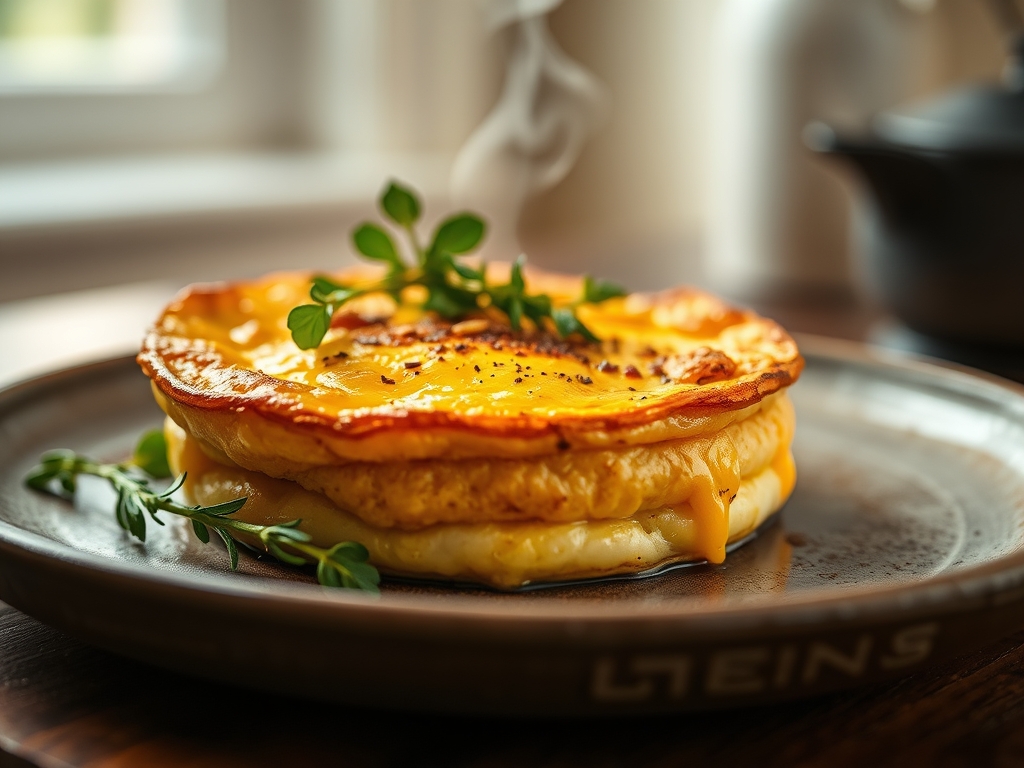
Look at the Masterclass photo above. Notice the uniform, pale gold crust and the extreme vertical lift. If your omelet looks "pock-marked" or has large brown spots, your heat was inconsistent. This usually happens when the pan is not properly preheated.
If the omelet appears dull or "matte" rather than glossy, you likely over-beat the whites until they became dry. Dry whites lose their elasticity and will not stretch during the cooking process. To fix this, ensure you stop whisking the moment you hit stiff peaks. If the omelet looks flat, you likely took too long to fold the yolks, allowing the air to escape. The visual cue for success is a "crease" that looks like a plush pillow.
THE DEEP DIVE
Macro Nutrition Profile:
A standard three-egg soufflé omelet provides approximately 21g of protein, 18g of fat, and 2g of carbohydrates. It is a high-density fuel source designed for cognitive clarity.
Dietary Swaps:
- Vegan: Use aquafaba (chickpea liquid) whipped with cream of tartar and a pinch of kala namak (black salt) for that sulfurous egg flavor.
- Keto: This dish is naturally keto-compliant. Increase the fat by adding a tablespoon of heavy cream to the yolks.
- GF: Naturally gluten-free. Ensure your spices are not bulked with flour.
Meal Prep & Reheating Science:
You cannot meal prep a soufflé omelet. The molecular structure relies on trapped air that will inevitably escape as the temperature drops. Reheating in a microwave will turn the delicate protein lattice into a rubbery puck. This dish must be consumed within three minutes of leaving the pan to experience the intended texture.
THE KITCHEN TABLE
Why did my omelet collapse instantly?
You likely under-beaten the egg whites or folded them too aggressively. Without a strong protein network, the air escapes as soon as the heat source is removed. Ensure your peaks are stiff and your folding motion is gentle.
Can I add vegetables like peppers or onions?
Yes, but they must be sautéed separately first. Raw vegetables release moisture during cooking, which will weigh down the foam and turn your soufflé into a soggy mess. Always infuse your fillings with flavor before adding them.
What is the best pan for this audit?
A high-quality non-stick skillet is non-negotiable. Carbon steel or cast iron can work if they are perfectly seasoned, but the delicate nature of the egg foam usually requires the frictionless surface of a modern non-stick coating.
Do I really need cream of tartar?
While not strictly required, it is your insurance policy. It prevents the proteins from over-coagulating, which leads to a smoother, more elastic foam. If you lack it, a few drops of lemon juice or white vinegar work.